
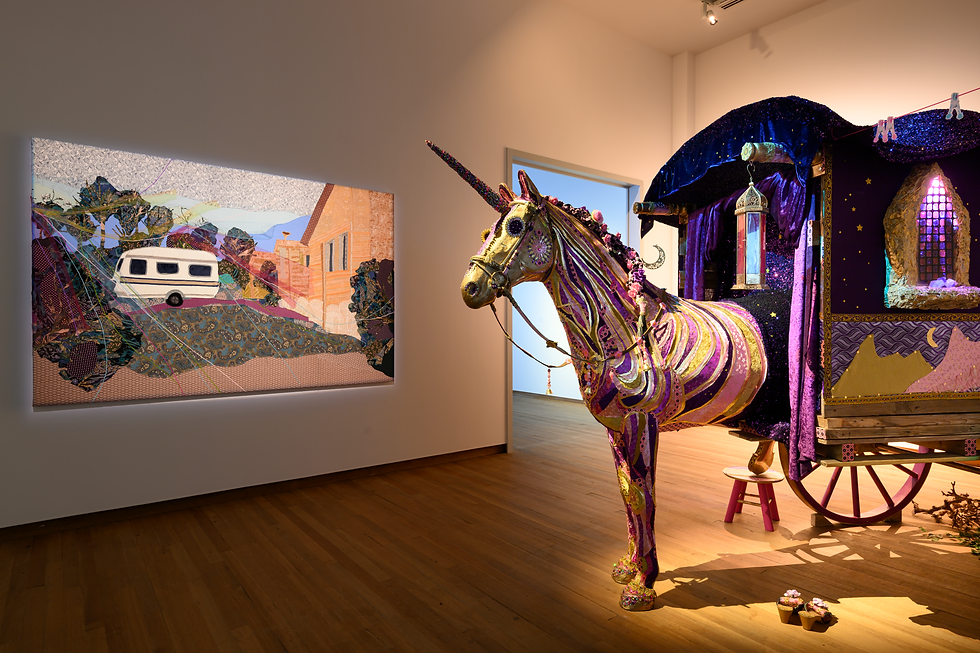
Sonnekasko
Djiephen
Photocredits: Peter Cox


The story of Sonnekaskro Djiephen
Morena Bamberger ( Roermond, 1994 ) made a large installation commissioned by the Bonnefanten.
The work, Sonnekaskro Djiephen, Sinti for a life of gold, will be included in the collection. It forms the transition between the collection presentation DREAM ON and the solo exhibition of Malgorzata Mirga-Tas. Bamberger made the trailer in close consultation with Mirga-Tas.
This trailer, and especially its wheels, speaks to the heart of Sinti and Roma culture.
It symbolises constant movement. Not surprisingly, the wheel is centrally depicted on the Sinti and Roma flag. Bamberger sees the caravan as a chapel, a small shrine that honours the lifestyle and culture of the Sinti and Roma. Even though they no longer travel, they keep their customs close to their hearts.
Projected onto the laundry, hanging on the line to dry, are two films. They are from 2017, when Bamberger was still in art school and struggeling with her identity as an artist. Being an artist had not been something she was taught from home: her family struggled so much with Bamberger's choice of profession that it led to a split. In these films, we see Bamberger firt tentative rapprochement.
In the first film, Bamberger portrays the trailer park she grew up in and her family, viewing herself as an artist through the eyes of her family. In the second film, she uses the caravan camp as a studio amd looks at Sinti culture from the point of vieuw of being an artist.
The story of back to the pack and the playing creature
A bridge between my artistic practice and my Sinti roots
Morena’s artistic skills started when she was only a young Sinti-girl who was raised in a Sinti- settlement near Roermond in The Netherlands. For centuries gipsy’s like the Sinti’s are well known for their intuitive skills, close relations with mother-nature, their passionate music, fires, and romantic nomadic lifestyle. But unfortunately Sinti's and Roma were persecuted and banned for centuries because of their exotic Indian looks and traditional nomadic lifestyle. During the second Worldwar half a‘milion Sinti and Roma were deported and brutally killed. And this left another huge scar on the entire community. Morena does not profile herself as a Sinti artist, but many people find her past interesting in relation to her works. Spirituality, connection and intuition are a secret key in the Sinti and Roma community.
Morena's dream is to create artworks by using the intuitive skills and spiritual insides that ensue from her roots.
In 2017 she created two beautiful movies about her roots where she invited her family into her artistic world by a series of performances. It was a difficult task for her to create these movies, because she recently broke up with her family and she had to overwin ancestral patterns of shame, fear and even guild. But eventualy these movies were creating a lovely en authentic bridge between her artistic practice and her roots. 'It was the most healing artwork I've ever made.'
It is all the more special that the Polish Roma artist Malgorzata Mirga-Tas was inspired by these films. From Morena's video images she created a series of new portraits for her first Dutch solo exhibition in the Netherlands at the Bonnefantenmusuem Maastricht. For her first solo, Malgorzata collaborated with Morena to also tell the story of the Sinti people in the Netherlands. Morena was commissioned by the museum to create a new installation about her Sinti roots, in which her two films are also shown.
"My family is a huge source of inspiration for me because they don’t believe in a clock that wakes you up to go to school or to work. They measure the value of time with an inner compass: A free heart’’. When I create art with a heart like this I can capture the mystical spheres and messages of my spiritual adventures very accurately. In order to share them with the world''
Morena Bamberger

